
AI Strategy
How to Become Part of the 5%: The AI Playbook
Only 5% of enterprise AI initiatives create meaningful ROI. That gap is a roadmap, not a dead end. Learn the thoughtful, disciplined process to help organizations become part of the 5%.
By Thalor Team
AI is creating real business value, but the results are uneven. According to the State of AI in Business 2025 report, only 5% of enterprise GenAI initiatives are successfully creating meaningful ROI. That leaves 95% of organizations with an important question: what can they learn from the initiatives that are working?
The playbook starts with a simple principle:
Don't start with the technology. Start with the problem.
Becoming part of the 5% isn't about finding the perfect AI model or betting on the next breakthrough. It's about following a disciplined process for finding the right problems, proving value, learning quickly, and using what you learn to take on increasingly valuable opportunities.
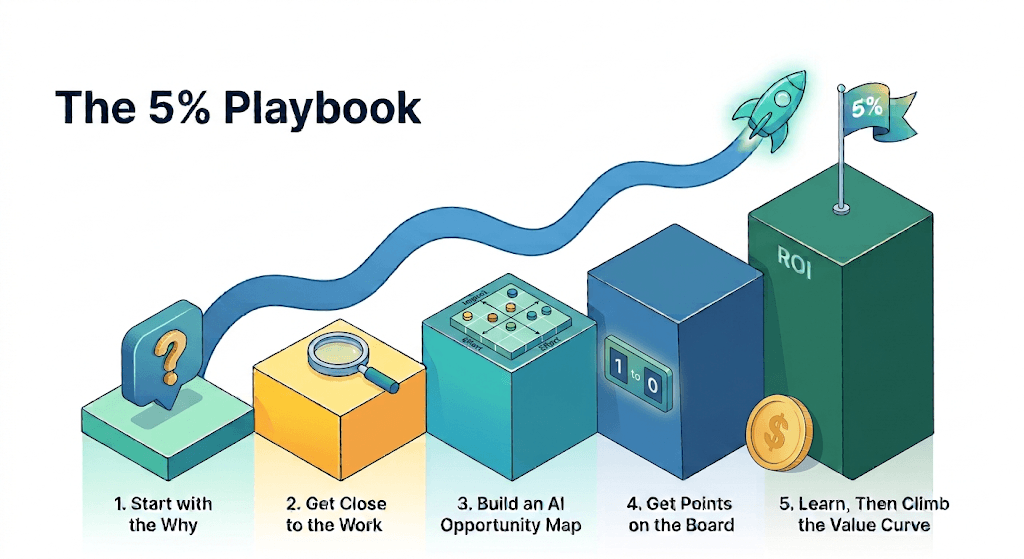
The 5% Playbook
1. Start With the Why
Before asking "How can we use AI?", ask: why does this problem matter? Understand the customer, employee, workflow, and business outcome.
The rapid growth in demand for forward-deployed engineers is a reflection of this shift. Companies are putting technically capable people directly alongside customers because understanding how work actually happens is often more valuable than understanding what the technology could do.
Technology should be the answer to a problem, not the starting point for finding one.
2. Get Close to the Work
Don't rely on a requirements document. Watch the work happen. Talk to the people doing it. Understand:
- Who does the work
- What they do
- What information they need
- Where the bottlenecks are
- What decisions require judgment
- What happens when something goes wrong
- What the problem costs
This is where you discover the problems that actually matter.
3. Build an AI Opportunity Map
Now take everything you've learned and identify opportunities. Lean on the people who understand the business best to define the potential impact: what could improve, who would benefit, and how the result could be measured. The technical team can then help define the effort involved, including the data, integrations, systems, and workflow changes required. By working together, the business and technical teams can weigh the potential impact against the effort and determine where to start.
Don't chase the biggest possible project. Chase the highest-value project you can successfully execute right now.
4. Get Points on the Board
Take a meaningful but achievable opportunity and deliver it. Not a science project. Not a proof-of-concept that lives in a demo. Something people actually use. Then measure the outcome:
- Did it save time?
- Increase throughput?
- Reduce errors?
- Increase revenue?
- Improve customer experience?
Whatever the metric, prove that the project created value. Now you have your first point on the board.
5. Learn, Then Climb the Value Curve
An achievable first project does more than create immediate value. It also becomes a learning engine. The ROI from that first project is not just the value it generates. It is also everything you learn while doing it:
- Your people — how they actually work
- Your customers — what they actually value
- Your data — what exists and what's missing
- Your systems — what it takes to integrate
- Your AI — where it performs and where it doesn't
- Your organization — what it takes to deploy and adopt
That knowledge compounds.
Getting points on the board solves three problems:
- It creates value early.
- It helps the team learn about the business, users, and problems.
- It builds the experience needed to tackle the largest business challenges.
The point of starting with achievable projects is not to stay small. It is to create value as you go while building the context, trust, and experience required to take on larger, more complex, and higher-impact projects later. You go: understand, prove, learn, scale. Eventually you can tackle the projects that would have been too risky on day one because you have earned the context required to execute them. That's the playbook.
Becoming Part of the 5%
Becoming part of the 5% isn't about predicting the future of AI. It's about understanding your business well enough to know where AI can create value today.
Start with the customer. Understand the problem. Prioritize ruthlessly. Get a meaningful win. Learn from it. Then use what you've learned to tackle something bigger.
The companies that consistently create value with AI aren't necessarily the ones moving fastest toward the newest technology. They're the ones learning fastest about where that technology can actually make a difference.
That's the playbook: be deliberate about where AI belongs, practical about how it gets adopted, and rigorous about proving that it creates value. The goal is not to chase AI for its own sake, but to build the context, trust, and measurable results that distinguish the 5%.
Discover. Plan. Integrate. Learn. Repeat.